
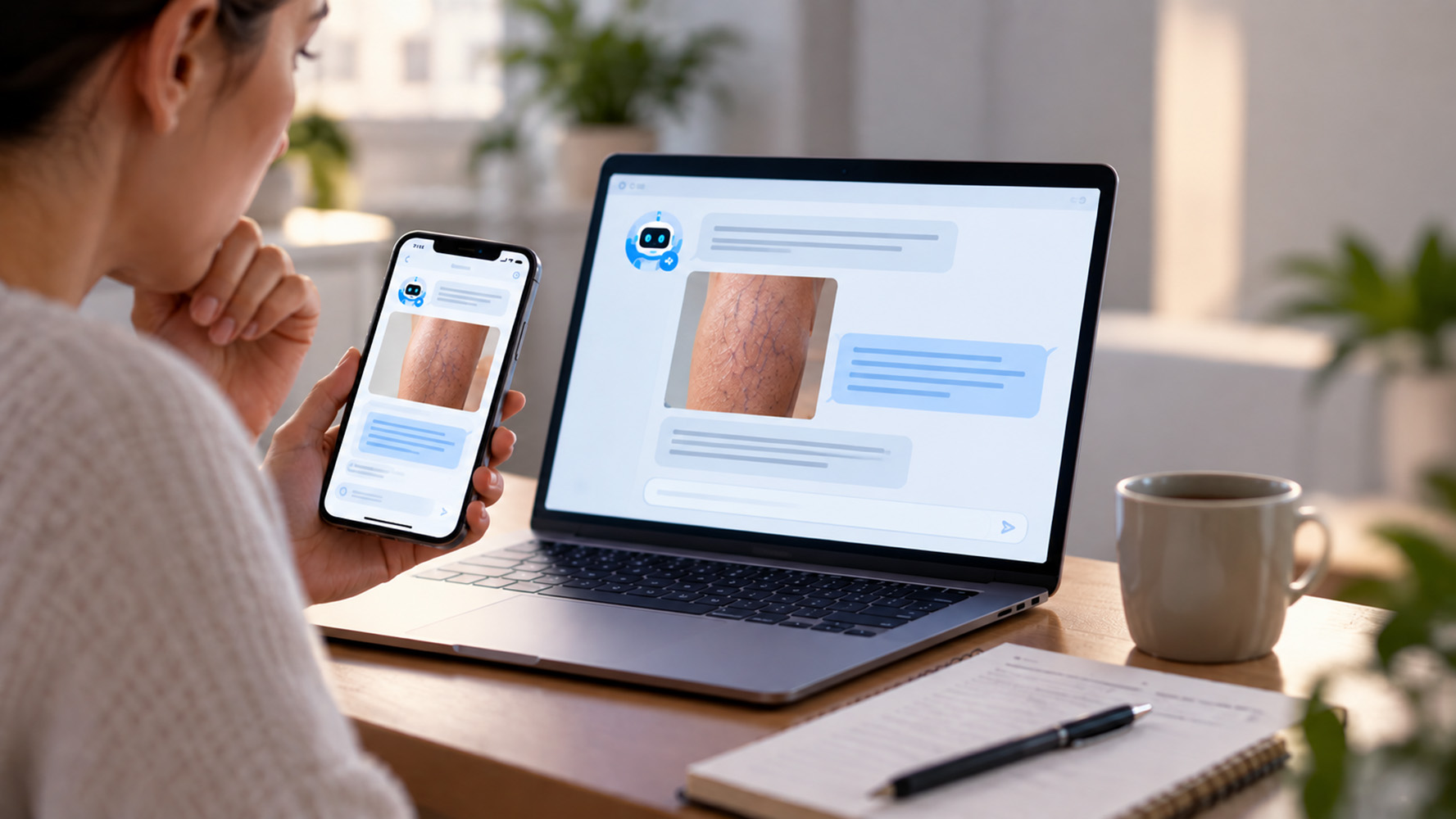
Uploading a photo to artificial intelligence or asking, “My legs are swollen. Could I have varicose veins?” now takes only a few seconds. AI systems can analyze symptoms, list possible causes, and provide explanations that may sound highly convincing.
So, can AI diagnose varicose veins?
Not on its own.
However, this does not mean that artificial intelligence has no role in vein disease. On the contrary, research in recent years suggests that AI could become an important supportive technology in the assessment of chronic venous disease.
There is one critical distinction:
Providing information about a disease is not the same as diagnosing a patient.
Proper assessment of varicose veins and chronic venous insufficiency does not depend solely on how the legs look from the outside. A patient’s symptoms, physical examination, and especially venous Doppler ultrasound findings should be evaluated together.
For this reason, AI is not currently a “varicose vein diagnostic system” that replaces a doctor. Instead, when used appropriately, it is a technology with the potential to support a physician’s evaluation.
Can AI Diagnose Varicose Veins?
Artificial intelligence systems can make assessments based on the information provided to them.
For example, specialized AI models that analyze photographs of the legs may classify visible veins or certain clinical signs of chronic venous disease. Large language models can also provide general information about symptoms described by a patient, such as swelling, discomfort, nighttime cramps, or visible veins.
However, there is an important difference between an answer provided by a chatbot and a clinical diagnosis.
A chatbot:
- Cannot physically examine your legs.
- Cannot see blood flow inside your veins.
- Cannot measure how well your venous valves are functioning.
- Cannot determine which vein is causing venous reflux.
- Cannot map your venous anatomy.
- Cannot independently rule out other conditions that may cause similar symptoms.
Therefore, saying, “I uploaded my photo to AI, and it told me I have varicose veins,” does not constitute a definitive medical diagnosis.
What Does Research Say About AI and Varicose Veins?
The use of artificial intelligence in venous disease is not merely theoretical. Significant research is already being conducted in this field.
A review published in JVS–Vascular Insights in 2025 evaluated current applications of artificial intelligence in chronic venous insufficiency.
Researchers reported that AI systems may make important future contributions to:
- Assessing disease risk.
- Analyzing factors associated with the development of varicose veins.
- Identifying patients who may benefit from treatment.
- Automatically analyzing medical images.
However, one of the important messages from the same research was this:
Many current applications are still at the “proof-of-concept” stage.
In other words, the technology is promising, but further validation studies are needed before it can replace physician assessment in routine clinical practice.
Can AI Detect Varicose Veins From a Photo of the Leg?
One of the most interesting areas of research involves the use of artificial intelligence to evaluate photographs of the legs.
Some AI models attempt to estimate the clinical stage of chronic venous disease based on visible changes in photographs.
For example, studies using different machine-learning and deep-learning models to assess clinical photographs have reported high accuracy rates.
However, there is an important point to keep in mind when interpreting these results:
Achieving high accuracy within a research dataset is not the same as reliably diagnosing every patient in real life.
A model’s performance can vary depending on:
- The photographs used.
- The patient population.
- Skin characteristics.
- Image quality.
- Lighting conditions.
- The stage of the disease.
More importantly, a photograph shows only the surface of the leg. The venous reflux responsible for varicose veins occurs beneath the skin.
How Are Varicose Veins Actually Diagnosed?
A proper varicose vein assessment involves much more than asking, “Can I see a vein?”
Visible veins may represent only the surface part of the problem.
During a vascular evaluation, the goal is to answer several important questions:
Which vein is affected? In which direction is the blood flowing? Are the valves functioning properly? Is venous reflux present? If so, where is it and how significant is it?
The evaluation therefore involves several steps.
The Patient’s Symptoms Are Evaluated
First, the patient’s symptoms are assessed.
These may include:
- Leg swelling.
- Discomfort that worsens toward the end of the day.
- Cramps.
- Itching.
- Visible varicose veins.
- Discoloration around the ankles.
- Skin problems.
- Open wounds in advanced cases.
It is also important to understand when the symptoms started and how they change throughout the day.
A Physical Examination Is Performed
The physician evaluates the legs.
The distribution of visible veins, swelling, skin changes, and other clinical findings are examined.
However, even a physical examination may not always be sufficient on its own.
This is because the vein visible from the outside may not be the vein responsible for the underlying problem.
Venous Doppler Ultrasound Is Performed
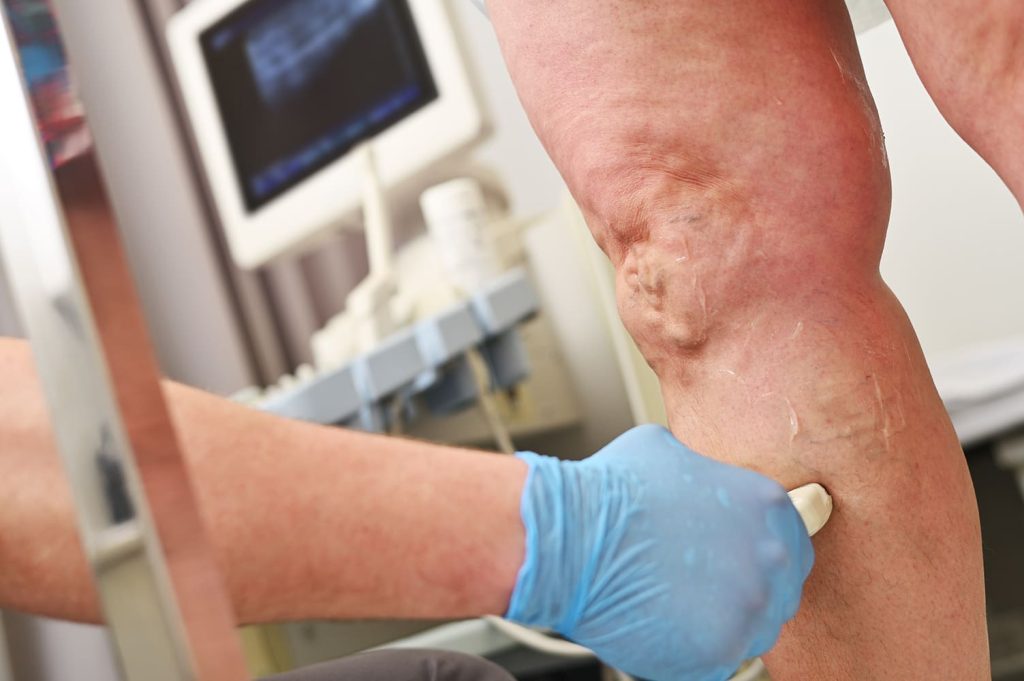
One of the most important methods used to evaluate varicose veins and chronic venous insufficiency is Doppler ultrasound.
Ultrasound allows the physician to assess not only the appearance of the veins but also the movement of blood through them.
This makes it possible to evaluate:
- Vein anatomy.
- The direction of blood flow.
- Venous valve function.
- The presence of venous reflux.
- The location of problematic veins.
This is the fundamental difference between simply describing your symptoms or showing a leg photograph to AI and undergoing an actual venous evaluation.
Why Can’t AI Replace Doppler Ultrasound?
A person may have very prominent veins on the surface of the leg while the underlying venous problem is different from what might be expected.
Conversely, very few veins may be visible from the outside even though significant venous insufficiency exists in deeper veins.
A standard photograph uploaded to AI cannot provide this hemodynamic information.
Doppler ultrasound, on the other hand, can evaluate blood flow inside the veins in real time.
For this reason, Doppler ultrasound remains one of the fundamental diagnostic methods for evaluating chronic venous insufficiency.
H2 What Are the Risks of Seeking a Varicose Vein Diagnosis From AI?
One of the greatest advantages of artificial intelligence is its ability to provide fast answers. However, when it comes to health, speed does not always mean accuracy.
Some of the most important risks include:
False reassurance: AI may interpret your symptoms as a simple varicose vein problem, potentially causing you to delay proper medical evaluation.
Unnecessary anxiety: The opposite can also happen. A normal or insignificant finding may be interpreted as a serious vascular condition.
Confusing similar conditions: Leg swelling or skin changes are not specific to varicose veins.
Inability to identify the source of the disease: Determining where varicose veins originate requires assessment of venous anatomy and reflux.
Incorrect treatment expectations: It is not appropriate to develop a treatment recommendation based only on symptoms before the diagnosis has been clarified.
Perhaps the most important issue is that an incorrect AI-generated answer can still sound highly convincing.
Is AI Used as a Supportive Tool in Varicose Vein Diagnosis?
This is an especially interesting area.
There is a major difference between AI simply analyzing a photograph uploaded by a patient online and AI supporting an ultrasound examination performed by a physician.
In the second scenario, artificial intelligence works with actual clinical imaging data.
Research suggests that AI-based systems have the potential to reduce variability in ultrasound interpretation and speed up image analysis.
Therefore, in the future, we may increasingly see a model that looks like this:
Vein specialist + Doppler ultrasound + AI-assisted image analysis.
However, the final clinical decision should still be made by the physician, who evaluates the patient’s medical history, physical examination, ultrasound findings, anatomy, and individual circumstances together.
What Should You Consider When Asking AI a Health Question?
You do not need to completely avoid artificial intelligence when seeking health information.
The important thing is to use it for the right purpose.
AI can be useful for:
- Learning what varicose veins are.
- Understanding medical terminology.
- Preparing for a doctor’s appointment.
- Creating a list of questions to ask your physician.
- Making general health information easier to understand.
However, you should not treat personalized statements such as “You have varicose veins,” “This vein is not dangerous,” or “You do not need treatment” as definitive medical diagnoses.
Which Symptoms Mean You Should See a Doctor Instead of Asking AI?
Professional medical evaluation is particularly important if you experience:
- Recurrent or progressively worsening leg swelling.
- Prominent varicose veins.
- Leg symptoms that worsen toward the end of the day.
- Nighttime cramps.
- Discoloration around the ankles.
- Itching or skin changes.
- Wounds that do not heal.
- Varicose veins that are becoming larger or more numerous.
The underlying cause of these symptoms cannot be reliably determined based only on external appearance or a written description of symptoms.
Conclusion: Can AI Diagnose Varicose Veins?
Entering a few symptoms into an AI system or uploading a photograph of your leg is not enough to diagnose varicose veins.
AI can be a useful starting point for obtaining general information. However, it is not the final step in diagnosing varicose veins.
When varicose veins or chronic venous insufficiency are suspected, the patient’s medical history, physical examination, and, when necessary, Doppler ultrasound findings should be evaluated together.
Frequently Asked Questions
Can AI diagnose varicose veins from a photo?
AI-based research systems can classify some visible features of chronic venous disease from photographs of the legs with high levels of accuracy. However, a standard photograph cannot show blood flow inside the veins or detect venous reflux. Therefore, a photograph alone is not sufficient for a definitive diagnosis.
Can ChatGPT tell whether I have varicose veins if I describe my symptoms?
It can provide general information about whether certain symptoms may be associated with varicose veins. However, it cannot provide a personal medical diagnosis. Because similar symptoms may have different causes, a medical evaluation is necessary.
What is the most important test for diagnosing varicose veins?
Doppler ultrasound is one of the primary imaging methods used to evaluate the venous system. It helps assess the direction of blood flow, venous anatomy, and the presence of venous reflux.
Can AI interpret Doppler ultrasound?
Active research is underway in this area, and some systems have shown promising results. However, these technologies should currently be regarded as tools that support specialist evaluation rather than replace it.
Can AI replace doctors?
Current research does not support this. Particularly in chronic venous disease, the more realistic role of AI is to support image analysis and clinical decision-making rather than replace physicians.
If I don’t have visible varicose veins, does that mean I don’t have venous insufficiency?
No. Venous problems are not always visible on the surface of the skin. Therefore, when symptoms are present, conclusions should not be based solely on external appearance.
Top of Form
Bottom of Form
Internal Sources
- Prof. Dr. Semih Barlas official web site
- Modern Treatment Methods for Varicose Veins
- Understanding Varicose Veins and Their Causes
- Contact
External Sources